Timeless is photographed on Ilford HP5 and Rollei Infrared 4x5 inch format film, with Fotoman 45PS, Wisner Expedition, Linhof Technika V, ZeroImage (pinhole) and Drãnoflex (pinhole) cameras, through various Schneider and Rodenstock lenses, on top of Manfrotto camera supports.
Film for Timeless is processed in Russ' Secret HyperExposure Sauce, which slows the sensitivity of some films to ISO 1/5000 or slower and expands their dynamic range to more than 25 stops. The secret sauce makes neutral-density filters for ultra-long exposure obsolete.
Original limited-edition dual-toned silver-gelatin prints, produced by hand in Russ' darkroom were scanned for this website. Those prints are available for sale. The print colours in this website are reasonable facsimiles of the original print colours.
The secret technology behind Timeless is still in research and development.
31 January 2009:
I think I'm the only one in the world that can do this today.
I kind of fell into researching very long exposures and carried on into inventing the specialized chemistry that makes hyper-exposure on film possible, thanks to a generous colleague, Richard Knotts, who introduced me to the work of Justin Quinnell in the
Trygg and Quinnell's technique involves placing black and white print paper in the pinhole camera, and after (perhaps) months of exposure, flatbed scanning the unprocessed paper, followed by digital processing to create their final result. Quinnell has an excellent description of his process on his website.
I was intrigued and amazed by their work, and since my personal practice doesn’t involve digital methods, I set about seeing if I could create printable film-based negatives after massive and unreasonable overexposure. In addition, I wanted a useful advantage of film over photo paper: film has a panchromatic response (while paper is orthochromatic), which allows film to capture a wider, and more natural (whatever that is) tonal scale.
After a great many attempts and failures, I’ve created a two-stage film development process that seems to permit arbitrary overexposure and yet produce normal negatives that can be printed in an entirely conventional manner.
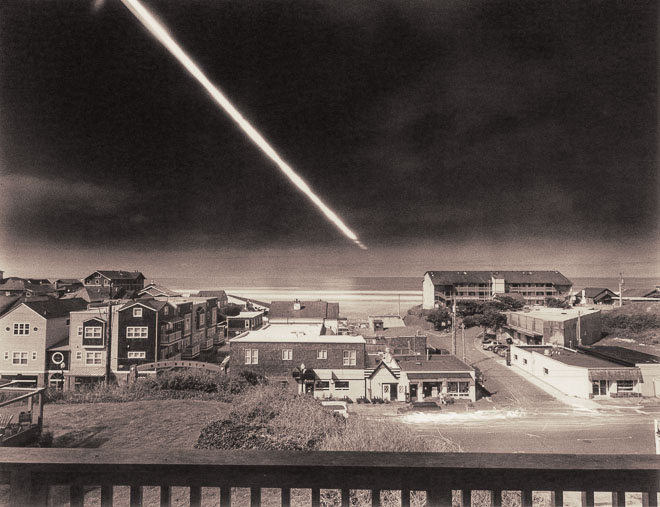
For example, one of the photographs in my current series was made on a sunny day (the sun’s arc spans the entire picture): a 6 hour exposure at f/4.5 on HP5 4x5 sheet film, with no filters. My back-of-the envelope calculation shows a 22 stop overexposure, some 4,000,000 times more exposure than “normal”.
Finally, many thanks to Stephen Anchell and Bill Troop for their terrific book, “The Film Developing Cookbook” - I got my copy through Amazon. While you won’t find my little invention in there, there are a great many clues to light the path.
This new ability to make lens and film-based photographs with arbitrarily long exposures has freed me to explore the effects of time. Now, I just need more time to play with it - this medium is not particularly prolific - at most, I can make just one exposure per day. There are more experiments in the works…
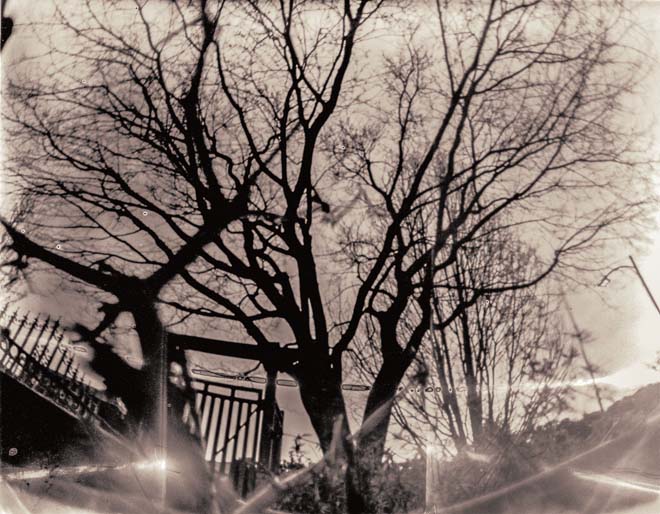
This photograph was made 21-24 January 2009, with four full days of exposure: two sunny days and two foggy days, with a pinhole camera (see my Drãnoflex article for information about my homemade pinhole camera - and how you can make a Drãnoflex). The sun arcs across the sky show the reciprocity failure brought about by extreme overexposure – much like Ansel Adam’s “The Black Sun, Owens Valley, California 1939”. Most of the other funny looking artifacts are light leaks around my pinholed piece of beer can - I need a better light seal if I'm going to leave the Drãnoflex outside for a long time.
17 March 2009:
I've been asked about that foggy look of these pictures: the effect is chemical fog caused by a physical development property of the chemistry I'm using. Earlier pictures have much more of this fog, but later refinements of the chemistry have made the fog go away almost completely. However, I've come to really like the fog, so I'm working on methods to re-introduce the fog in a controlled manner. Stay tuned!
18 May 2009:
I've been working the past couple of months to rebalance the chemistry to make the sunstreaks look more like daytime rather than nighttime. I've also tried to capture some of the moments of spring here in Vancouver - kinda hard as spring this year was very cold and wet. Anyways, there has been progress...
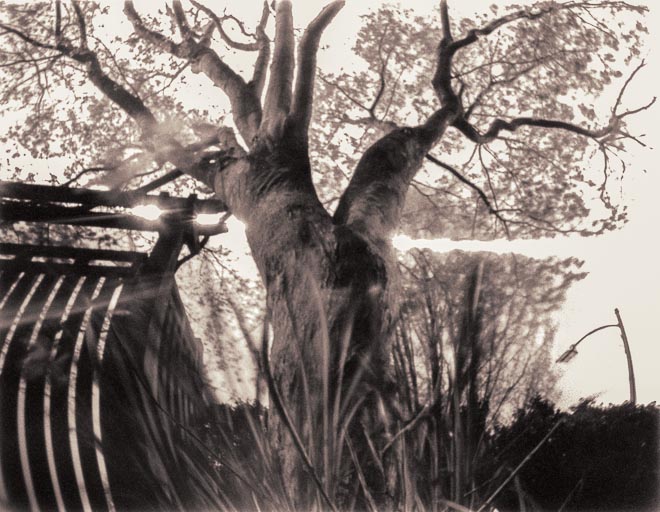
3 day exposure, Drãnoflex. Chemistry rebalanced to look more like daylight.
Summer 2010
I've started taking this technique out on the road - building a new body of work. It's still not clear exactly what the visual language needs to be, but I'm working on it.
Winter 2011
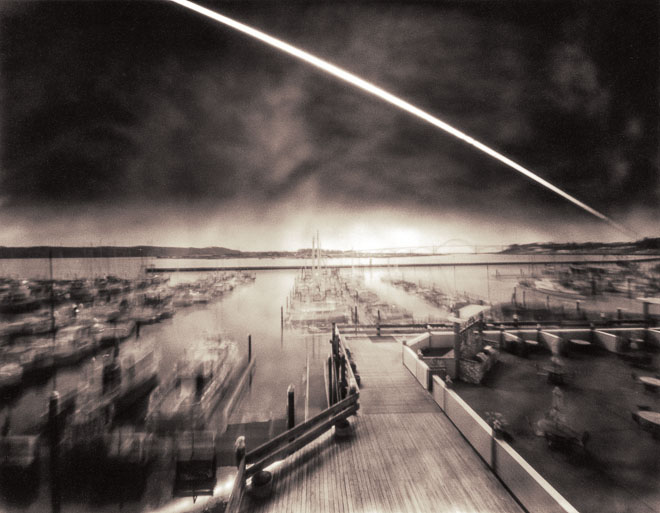
I've developed a reliable means to photograph scenes that read as day+night, as well as improved the tonal scale of the negatives to yield much clearer and brighter prints.
Summer 2011
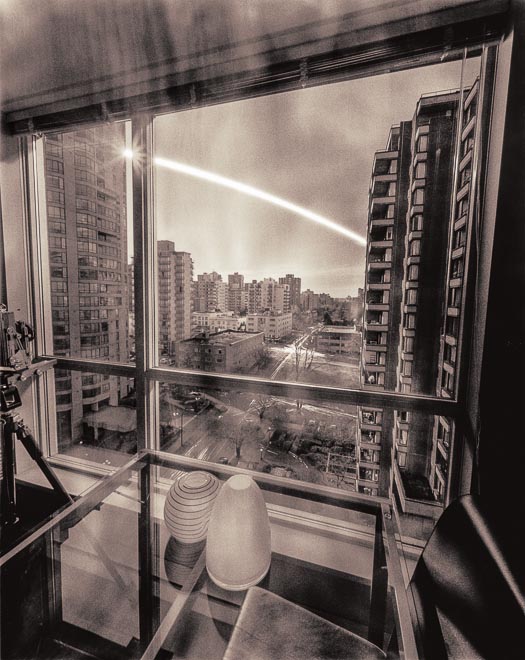
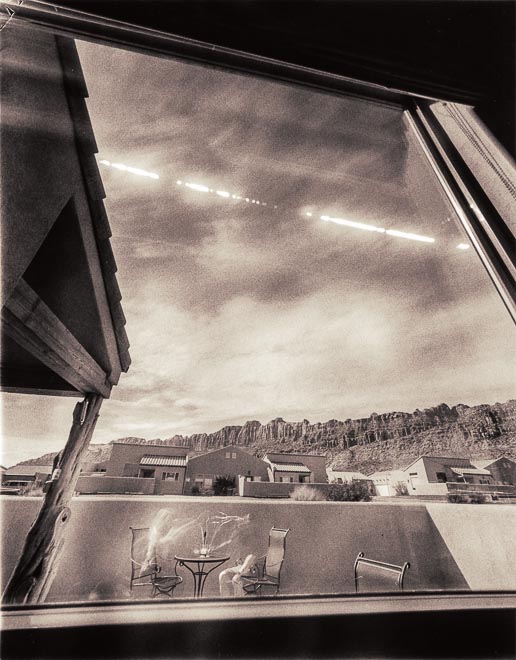
The visual language for my project is starting to become clear... it's not enough to show the passage of time simply by showing the path of the sun across the sky... I have a need to show the human activity of the day as well. I've added some camera handling technique to record people (Wendy and I sitting in the chairs) in the scene - yes, it still just a single shot with the shutter opening and closing exactly once. Impossible just takes longer to figure out.
2012
Ghosts are taking a leading role in some of the pictures. Of course, the ghosts I have most ready access to are Wendy and I. The techniques are still evolving, allowing an ever expanding dynamic range of the photographs, all still done with a single exposure over 24 hours.
Spring 2013
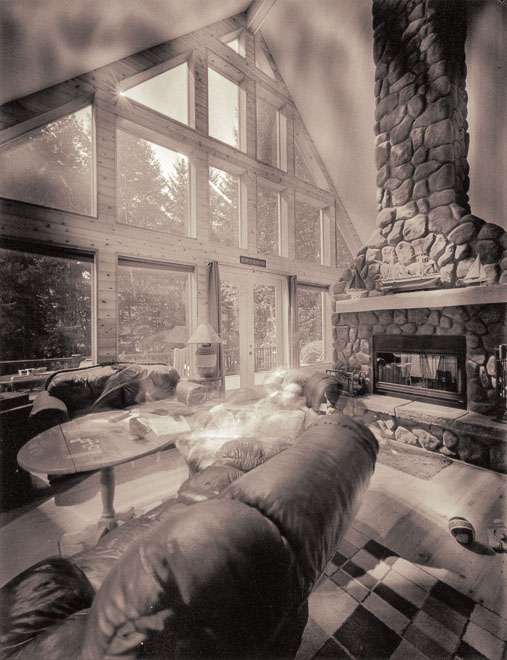
Pinhole cameras are having a mild renaissance. I'm currently taking two view cameras and one pinhole camera out on shoots, so I can get up to three pictures in a day.
Fall 2013
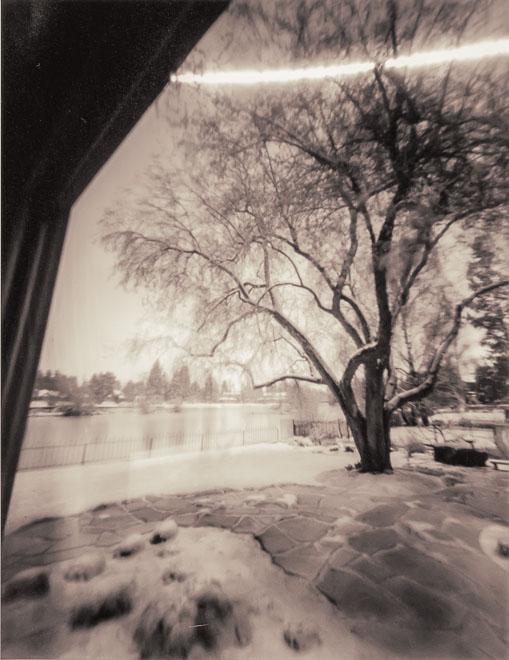
An experiment with Rollei Infrared film is coming to fruition. There is more tuning to do, but the visuals are awesome.
Spring 2014
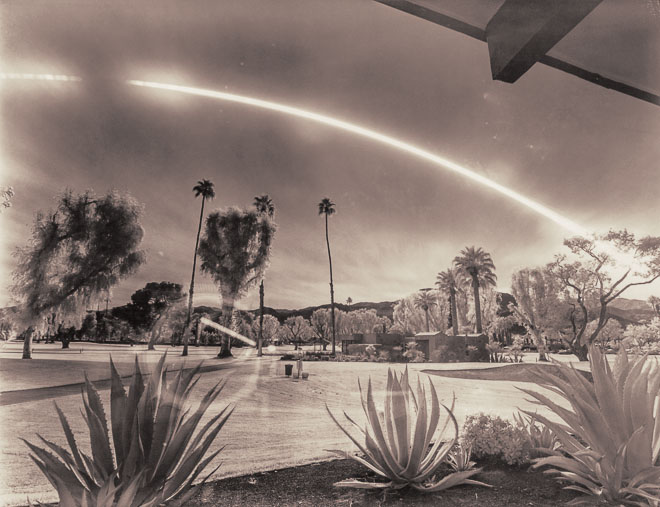
A further calibration of the chemistry has improved yield to the point where I have nearly no misses at all, and can create this day+night look - with good ol' HP5.
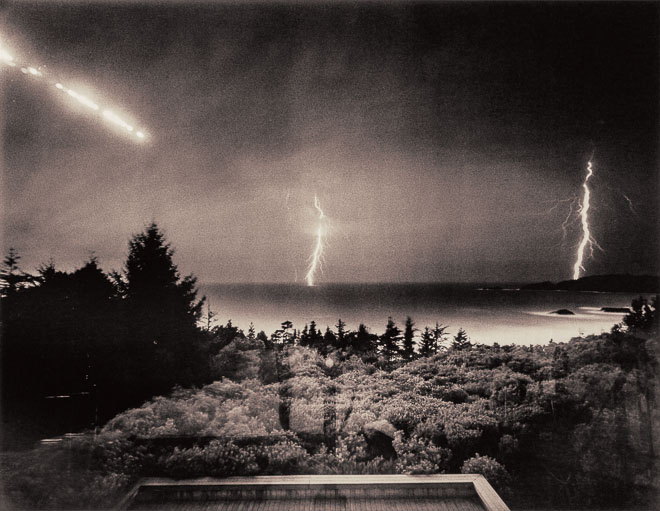
October 2016
Sometimes it's just luck. This giant thunderstorm blew in just after dark, after a stormy day with a brief sunset.
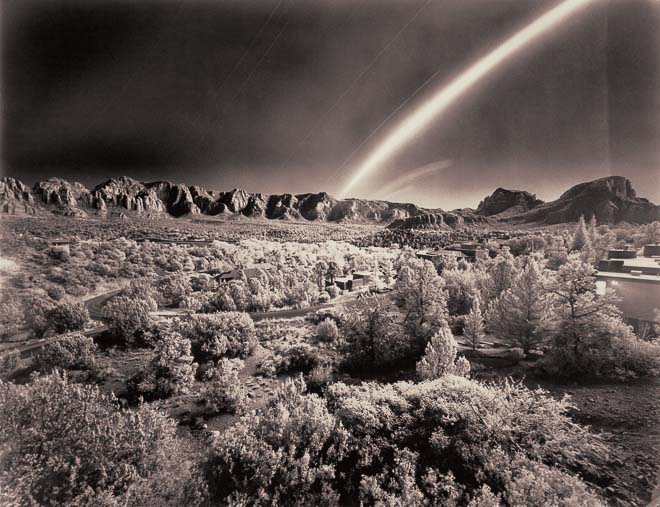
November 2017
Finally, a breakthrough: after trying for a few years, this is my first exposure that features a sun trail and star trails simultaneously. I have exactly one picture like this for now, and the process is a little unstable, but hopefully, I can stabilize it soon.
This picture is a 24 hour exposure, showing the eastern wall of the Oak Creek canyon just south of Sedona, Arizona.
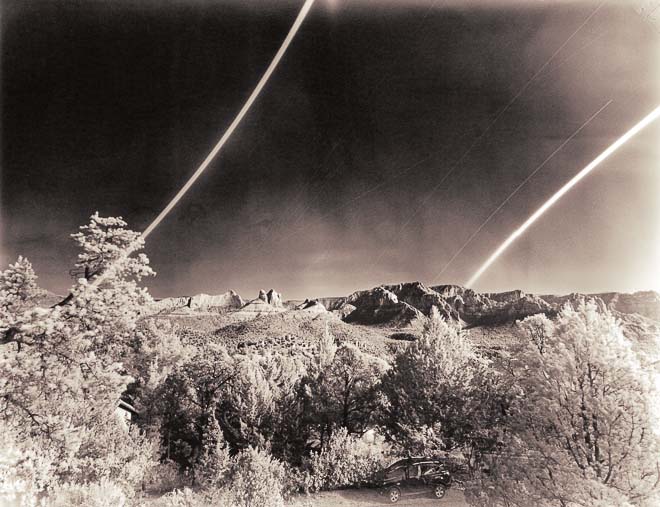
November 2018
The giant dynamic range process is now stabilized, and I can reliably record the sun and stars in the same exposure. This is my first picture that shows sunrise (the bright streak on the right), moonrise (the bright streak on the left), and star trails in the same exposure.
As it happens, we visited Sedona two years in a row (unusual for us), so this is once again a view (from a different vantage point) of the eastern wall of the Oak Creek canyon.
Google Analytics